
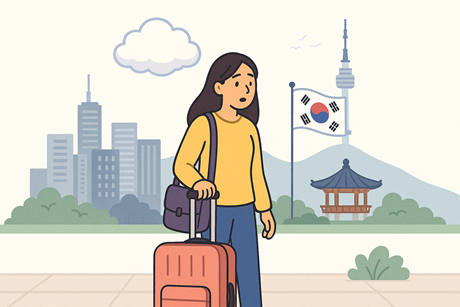
When I first came to Korea, my suitcase wasn’t just packed with clothes. It was full of emotions too excitement, a little fear, tons of curiosity… and that big question: “Will I be able to adapt?”
A whole new country, an entirely different culture, a language I didn’t know… But deep down, there was always a voice inside me whispering: “You’ll find your way.”
I had finally stepped into the colorful world I’d only seen on screens for years. It felt oddly familiar and completely unknown at the same time. Real life, though, didn’t play out like the dramas. Getting lost between grocery store aisles, trying to understand the address system, silently praying someone at the phone shop would understand me… Everything was unfamiliar, and honestly, sometimes overwhelming.
That’s exactly why I wanted to create KoStep. Because knowing you’re not alone, hearing that someone else walked the same path it’s comforting. Sometimes, all you need is someone saying, “I’ve been through this, let me walk with you.”
In this blog, you won’t find polished facts or textbook explanations. You’ll hear about real experiences. What was easy, what was hard, what took time to get used to…
Maybe you’re packing your own suitcase right now. Or maybe you’ve already arrived and still feel like a stranger. If so, let’s talk. Let’s share. Let’s figure it out together.
🚇 Twisty But Sweet Roads
The subway system? It felt like a maze at first. Everything was neat and efficient, but also… a bit overwhelming.
I didn’t know back then that exit numbers are everything in Korea. They’re not just signs; they’re the keys to not getting completely lost.
Those first few weeks, I struggled. Every station looked the same, and some signs were only in Korean. But eventually, it all started making sense. Now I even know which subway car is closest to the right exit. That’s when I realized “Yep, I’ve got this.”
The underground chaos slowly became familiar. What once looked like a giant Tetris puzzle started to feel like second nature.
Of course, getting the hang of the subway is just one part of life here. Daily tasks test you in other ways too finding an apartment, tracking down packages, figuring out utility bills… At first, it’s like, “Where do I even begin?” But once you get the hang of a few key apps, everything starts falling into place.
I’ll break it all down in future posts, don’t worry. Like I said you’re not alone here. I’ve walked this path, and now we’ll walk it together.
👭 A Social Life That Starts with Silence, Ends with a Smile
I remember thinking in my first week: “No one’s talking… Are people cold here?”
But I was wrong. It wasn’t coldness it was respect. Koreans are often reserved when meeting someone new. But once you break the ice, the warmth is real.
Especially older Koreans they’re wonderfully curious. You’ll hear all the classic questions:
“Where are you from?” “Why did you come?” “K-dramas? BTS?” 😄
But wait, there’s more! The famous duo: “How old are you?” and “Are you married?”
Why? Because secretly, everyone has a niece, nephew, or grandchild they’d love to introduce you to. Matchmaking is basically in their blood!
Some even get more excited when they realize you don’t speak Korean. They’ll talk slowly, with big gestures, trusting that you’ll understand. And honestly? You usually do.
Then there’s the expat community. Pure gold. Sometimes you meet someone from your home country and instantly click. Other times, you connect with someone from halfway across the world over a shared struggle, and that’s just as beautiful.
At first, building a social circle feels slow… but then these people? They become part of your story. And you think to yourself: “I’m so glad I met them.”
🎎 Cultural Differences That Grow on You
Life in Korea comes with its own set of unique rules—and at first, they totally catch you off guard. But over time, you grow fond of them.
Here, people address each other by age. It’s not just names it’s unni, oppa, ajumma, ajusshi.
At first, it feels weird that no one calls you by your name. But later, when someone doesn’t call you unni or oppa, it feels… off 😄
They also have a deep-rooted system called hoching a structure of respect and hierarchy based on age and status. It might seem overly formal at first, but it’s really about showing care and consideration.
People are super quiet in public spaces. Speaking loudly on the bus? A big no no. Even phone calls are taken in whispers. It feels strange at first, then becomes second nature.
And the fashion? Oh, don’t even try to run to the store in pajamas. Even someone just buying eggs looks like they stepped off a runway.
Then there’s the tech. Korea is filled with little conveniences: separate drying machines for clothes, keypad locks on doors, table-call buttons at restaurants…
At first, you’re amazed. Later, you wonder how you ever lived without them.
I’ll be diving deeper into all of this in upcoming posts. This was just a little window into the quirks and charms of life here.
Because…
This is only the beginning. There’s so much more to discover and we’ll keep learning together.